
A practical granulation solution for producing Urea Granulated Single Super Phosphate with improved handling, nutrient delivery, and field performance.
This page is structured around Jobson Enterprises' Urea SSP Granulation expertise, covering the USP / Urea GSSP process background, composition logic, process stages, major equipment flow, screening and recycle loops, dust control, and operational value for fertilizer manufacturing projects.
A phospho-nitrogenous fertilizer route built around urea and superphosphate to deliver a usable and market-ready granulated product.
Jobson’s granulation process presents Urea SSP Granulation as a complex NP fertilizer route, highlighting a composition such as 5:12:0:10 and positioning the product as a practical nutrient source delivering nitrogen, phosphate, calcium, and sulphur in granulated form.
The page also emphasizes that urea superphosphate can support bulk blending and can be combined with other fertilizer materials when required for target nutrient formulations. Compared with powder forms, granulation improves handling, reduces wash-away losses, and helps the product remain in soil for longer practical utility.
Nitrogen • Phosphate • Calcium • SulphurThe website frames the preparation route as a two-stage process that links reagent preparation with SSP granulation and ratio control.
The process background explains that Urea Superphosphate is made using urea as a cost-effective nitrogen source and phosphate rock as a cost-effective source of P₂O₅. It describes a method in two stages: first, preparation of a urea-based solution or reagent under controlled conditions, and second, feeding that preparation with SSP granulation while maintaining process ratio and granulator control.
The page also notes that the reaction is exothermic and that the process can produce USP granules suitable for granulation, bulk blending, or further blending with other fertilizer materials such as MOP / KCl, potassium sulphate, MAP, or DAP for broader NPK product strategies.
The process can be implemented in existing SSP plants by adding only a reactor for reaction of urea and phosphogypsum. The scheme for the two-step process is shown below.
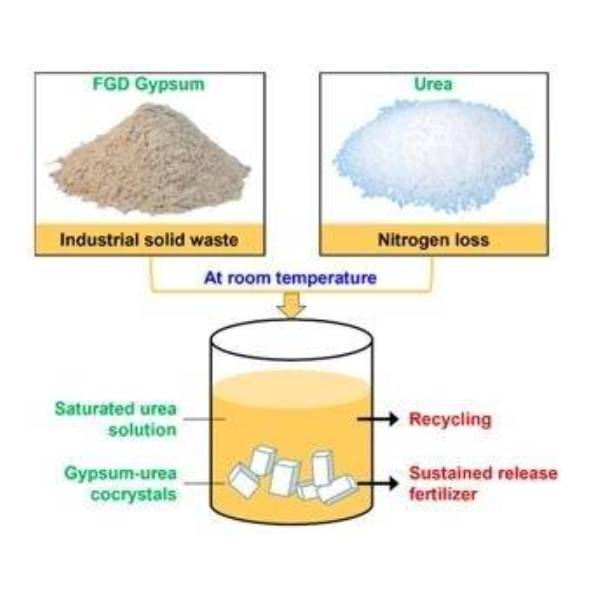
When mixing urea with gypsum in saturated urea solution, urea reacts with calcium sulfate dihydrate to form gypsum–urea.
This adduct, when added to SSP, does not react with MCP. Gypsum normally added to cured SSP as filler can be used for reaction with urea before granulation.
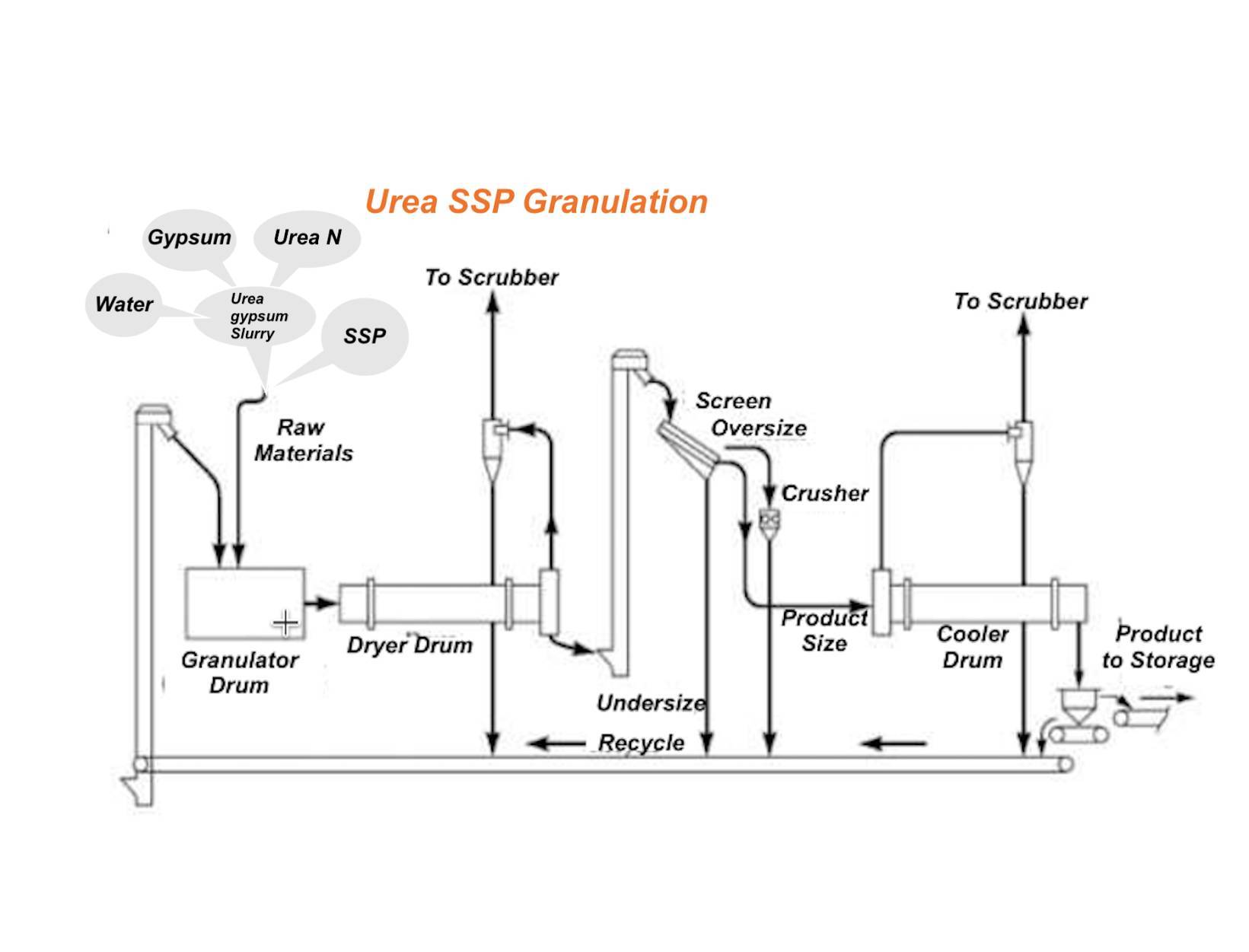
A drum-based granulation line with drying, cooling, screening, recycle, and dust-control integration.
According to the Jobson page, Urea Granulated Single Super Phosphate is manufactured by feeding SSP powder to the granulation plant. Inside the rotating granulator drum, the SSP powder is mixed with water up to about 12%, allowing granules to form from the powder feed.
The granules are then discharged to a dryer drum, where heating is used for drying, followed by transfer to a cooler drum. After cooling, the material moves to vibrating screens for desired mesh separation, while undersize and oversize fractions are handled through recycle and crushing loops to stabilize the plant output.
Granulation dust evolved in the process is managed through cyclone-based scrubbing and controlled air discharge.
The process description notes that USSP dust evolves during granulation and associated plant operations.
Dust is handled through a twin cyclone arrangement associated with the blower provided for the dryer drum circuit.
Air is discharged through a chimney indicated on the page at a height of 30 meters.
Improved physical form, easier handling, and compatibility with downstream fertilizer use patterns.
The Jobson page specifically highlights improved nutrient uptake efficiency and positions the product as a more useful form than powder because it does not dissolve as easily or get washed away as quickly. In practical plant and market terms, this supports better handling, better storage behaviour, and stronger application performance.
The page also notes that one advantage of the process is production of urea superphosphate compatible with bulk blending alongside fertilizers such as urea and triple superphosphate, creating wider formulation and marketing flexibility.
Urea SSP is a NP complex fertilizer which incorporates urea nitrogen along with phosphorus in SSP and thereby supplies both N and P. It contains 5% nitrogen, 15% P₂O₅ and 10% Sulphur.
| Specification Parameter | Value / Requirement |
|---|---|
| Moisture percent by weight, maximum | 3.0 |
| Total Nitrogen percent by weight, minimum | 5.0 |
| Urea Nitrogen percent by weight, maximum | 4.0 |
| Available Phosphorus as P₂O₅ percent by weight, minimum | 15.0 |
| Water Soluble Phosphorus as P₂O₅ percent by weight, minimum | 12.5 |
| Sulphate Sulphur as S percent by weight, minimum | 10.0 |
| Particle Size | Minimum 90% of the material shall be retained on 1 mm IS sieve and 4 mm IS sieve. |
Whether you are evaluating a new granulation line, reviewing process flow, or planning project support for Urea GSSP production, Jobson Enterprises can help shape the technical direction with practical fertilizer-plant understanding.