
Technical guidance, process understanding, and plant support for concentrated phosphate fertilizer production.
This page is based on Jobson Enterprises' TSP content and presents triple super phosphate manufacturing in a cleaner, more structured layout covering process background, reaction logic, production stages, gas scrubbing, and plant flow requirements.
This page explains that triple super phosphate is manufactured from phosphate rock containing around 45 30% to 55 32% P2O5, reacted with concentrated phosphoric acid under controlled conditions. It also notes that TSP is significantly more concentrated than ordinary superphosphate, delivering about 45% to 46% available P2O5.
Jobson also states that the present SSP process can be adapted for TSP manufacturing with only minor process changes, making this route relevant for plants evaluating technology extension or conversion opportunities.
Concentrated Phosphate • SSP-Based Adaptation • 45–46% Available P2O5These highlights represent the operating window used to determine optimum production conditions for triple super phosphate.
The page lists a reaction time range of 45 to 120 minutes for evaluating and optimizing TSP production conditions.
Phosphoric acid concentration is described in the range of 45% to 60% by weight for the production study referenced on the site.
The source page notes a reaction temperature range of 90°C to 100°C as part of the optimum-condition framework for TSP manufacture.
Jobson describes TSP manufacturing as similar to single superphosphate production, but configured for concentrated phosphoric acid reaction and TSP-grade output.
Triple Super Phosphate Is A Fertilizer Produced By The Reaction Of Concentrated Phosphoric Acid With Phosphate Rock Containing 45 To 55% P O . The Method Has Been Used To Determine The Optimum Conditions For The Production Of Triple Super Phosphate. The Chosen Experimental Parameters And Their Ranges Were .
This Type Of Fertilizers Is Much More Concentrated Than The Ordinary Superphosphate, Containing 45- 46 % Of Available P O . Triple Superphosphate Is Manufactured By The Action Of Phosphoric Acid On Phosphate Rock.
A Process Similar To Single Superphosphate Production Is Used, In Which Pulverized Phosphate Rock Is Mixed With Phosphoric Acid In A Two-Stage Reactor & Some Part Of Sulfuric Acid. The Resultant Slurry Is Sprayed Into The Granulator. The Slurry Is Sprayed Into The Drum Granulation Co-Current With Flue Gases Of Fired Fuel (Natural Gas Or Fuel Oil And Air). The Product Is Screened And Off-Size Is Recycled Back To The Granulator. The On-Size Product Is Cooled And Stored Ready For Being Bagged. The Exhaust Gases From The Reactor, Granulator And Cooler Are Scrubbed To Remove Fluoric Compounds.
The main process chemistry is the reaction of phosphate rock with phosphoric acid to produce triple superphosphate. The practical emphasis is on process suitability, concentration, and industrial fertilizer output.
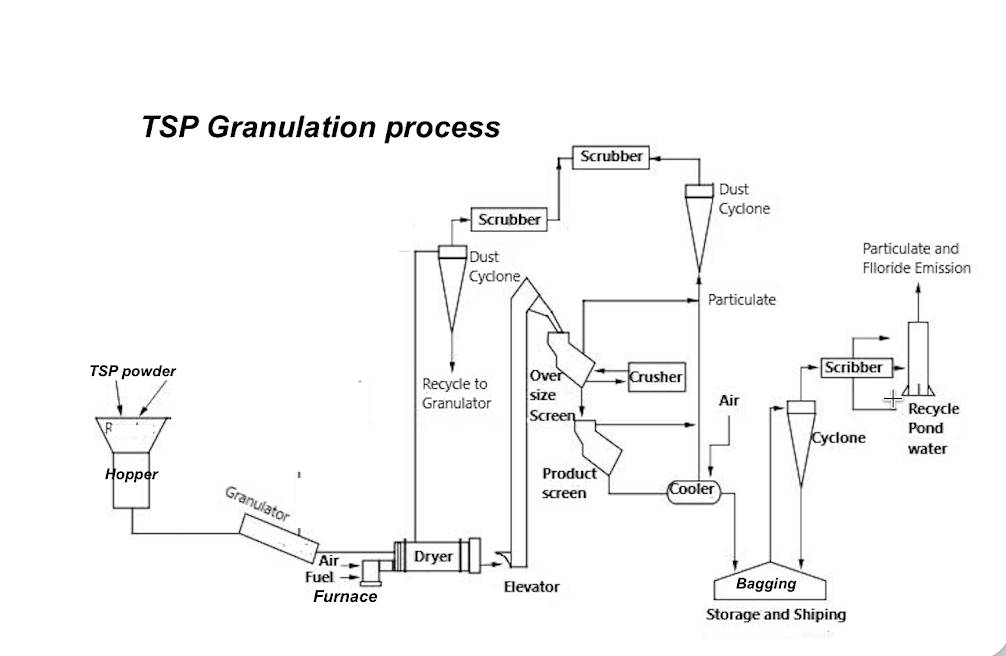
GTSP is manufactured by feeding TSP powder in the granulation plant. In the rotating granulator drum, powdered TSP is mixed with water up to 14 %which result in formation of granules. Granules are dried with 6% as final moisture content. The material comes from dryer are cooled in cooler drum. After cooling of the granules, they are sent to vibrating screens of desired mesh. Two types of vibrating screens are present. Undersize vibrating screen: in this size shall be -1 mm. oversize material of this screen will be send to next screen whereas under size material shall be recycled to the granulator drum.
Oversize vibrating screen: here the material size shall be +1 -4 mm. Oversize material retained on this screen will be sent to the crusher where crushing takes place and recycled to the granulator drum. Oversize material will be packed in 50 kg HDPE bags for sale as GTSP.
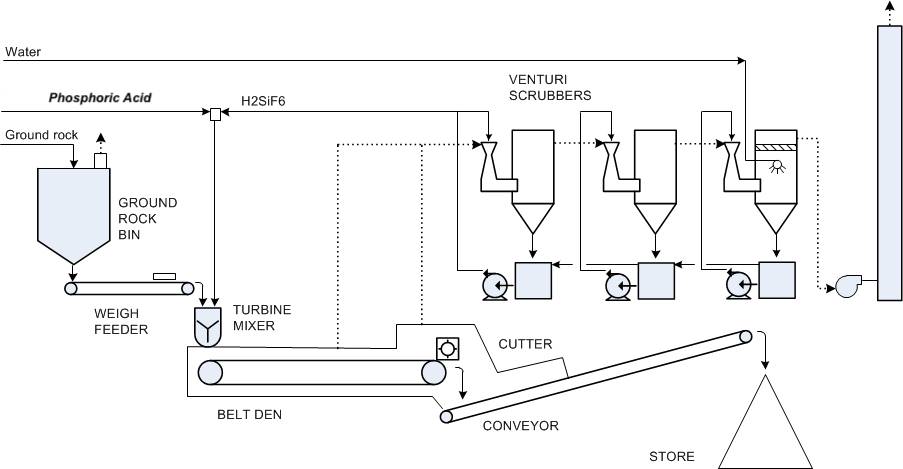
The website content can be translated into a straightforward industrial sequence from reaction to finished fertilizer packing.
Phosphate rock and concentrated phosphoric acid are reacted in a two-stage system to generate process slurry or powder for downstream granulation after curing.
The powder slurry is sprayed or fed into the granulator, where controlled particle buildup takes place in the presence of process water and steam.
Finished size is separated, while off-size particles are recycled to support granulation efficiency and product uniformity.
On-size product is cooled, stored, and held ready for final bagging and dispatch from the plant.
The source page specifically notes exhaust-gas handling for removal of fluoric compounds from process sections.
Jobson states that the exhaust gases from the reactor, granulator, and cooler are scrubbed to remove fluoric compounds. This makes emissions control an integral part of the manufacturing line rather than a secondary utility consideration.
For plant planning and engineering, this means the TSP section should be considered together with gas handling, scrubbing, process safety, and environmental support systems from the earliest stage of design.
A cleaner presentation helps convert the technical source material into a stronger business-facing expertise page.
Explains how TSP differs from ordinary superphosphate through concentration level and process route.
Shows that existing SSP process logic may be extended for TSP with controlled process modifications.
Makes the line sequence easier to understand from reaction through granulation, screening, cooling, and packing.
Highlights that scrubbing and fluoric-compound removal are essential parts of the total plant concept.
A better-structured expertise page helps translate technical capability into consultative value.
Clear explanation of the TSP production route, feed chemistry basis, and plant-stage logic.
Better connection between process description and design, engineering, commissioning, or revamp opportunities.
Specific visibility into scrubbing requirements and emissions-related process integration.
Whether you are planning a TSP facility, evaluating SSP-to-TSP adaptation, or defining granulation and scrubbing requirements, Jobson Enterprises can support the next stage with practical and technically grounded process expertise.