
Design, engineering, and process guidance for NPK fertilizer production plants.
A complete section-wise page built from the supplied Word content, covering fertilizer basics, nutrient roles, NPK grade logic, process flow, raw materials, machinery, advantages, specifications, and client value.
Fertilizer is a material that is added to the soil to supply one or more elements required for plant growth and productiveness. The major three elements are nitrogen, potassium and phosphorus. Secondary elements include calcium, sulphur and magnesium, while other important elements include boron, manganese, iron, zinc, copper and molybdenum.
Nutrients: Nitrogen, Phosphorus And Potassium (N, P And K) For Various Crops And Growing Conditions. N (Nitrogen) Promotes Leaf Growth And Forms Proteins And Chlorophyll. P (Phosphorus) Contributes To Root, Flower And Fruit Development. K (Potassium) Contributes To Stem And Root Growth And The Synthesis Of Proteins. The Common Inorganic Fertilizers Include Ammonia (82% Nitrogen), NPK Combinations, Urea, Superphosphate, Mono And Dibasic Ammonium Phosphates (Containing Nitrogen And Phosphate), Calcium Ammonium Nitrate, Potassium Chloride (Muriate Of Potash)
The NPK manufacturing process is explained as a progression from raw material selection through intermediate processing and into finished multi-nutrient products. Nitrogen, phosphate, and potash inputs are combined in required proportions to produce crop-specific fertilizer grades.
Jobson positions NPK granulation as a process where mixed nutrients are converted into uniform granules, commonly in the 1 mm to 4 mm range, with the production line optimized for formulations such as 15:15:15 and other required grades.
Uniform Granules • Custom Grades • Crop-Specific FormulationsThe source content explains the role of nitrogen, phosphate, and potash within fertilizer manufacturing and how they contribute to complex multi-nutrient products.
Ammonia is described as the intermediate product for many nitrogen fertilizers and a core component in multi-nutrient fertilizer manufacturing.
Rock phosphate is processed into plant-available forms using acids, forming products such as SSP, TSP, MAP, DAP and complex fertilizers.
Potassium minerals are refined and concentrated before use, supporting both straight potassium fertilizers and multi-nutrient fertilizer production.
Complex NPK fertilizers have a uniform nutrient ratio in each granule, achieved through formulation and process control before and during granulation.
NPK ratings represent nutrient proportions and are selected according to crop needs.
The N value represents actual nitrogen content, while phosphorus and potassium are commonly expressed in oxide-equivalent form as P2O5 and K2O. Crop-specific recommendations and fertilizer grades can be tailored for rice, wheat, potato, sugarcane, and other applications.
This grading logic is central to plant planning because it influences raw material combinations, process settings, blending ratios, and final product performance in the market.
The numbers in a fertilizer grade represent the percentage of nitrogen, P2O5, and K2O in the mixture, allowing formulas to be selected according to crop requirements.
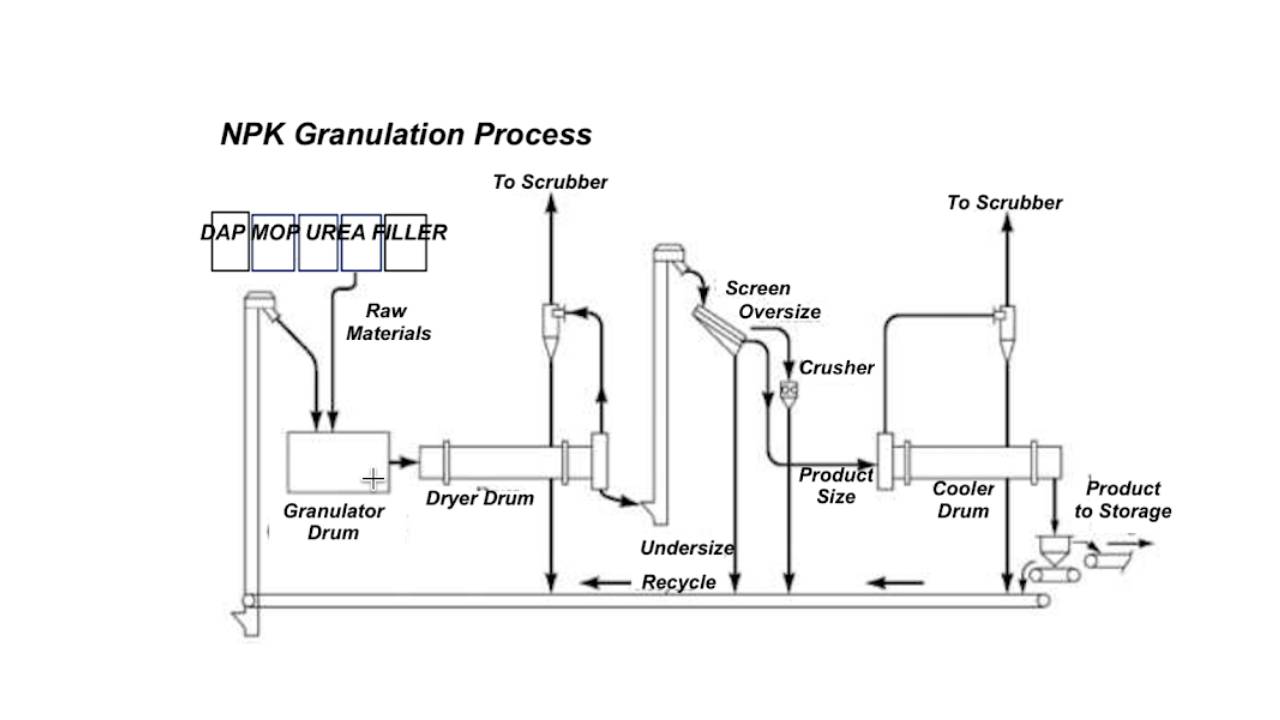
A continuous route from weighing and blending to granulation, drying, cooling, screening, recycling, and packing.
The raw materials are weighed on belt conveyors and moved to the mixer for producing a homogeneous mixture. The material is mixed with recycle material and taken for granulation in the granulation drum, where partial granulation is achieved with a very fine jet of water spray. Fine powder gets deposited on small nuclei to develop granules.
The process can be controlled to produce particle size as per customer demand. Material is taken to the dryer drum where hot air generated in the furnace evaporates water and dries the material. It is then cooled with ambient air in the cooler drum. Desired homogeneous particles, commonly 1–4 mm, are obtained using vibrating screens. Oversize material after crushing and undersize material are recycled.
Raw materials are weighed on belt conveyors, blended in a mixer, and combined with recycle material to form a homogeneous feed.
The blended material enters the granulation drum where fine water spray supports particle buildup and controls particle size.
Hot air from the furnace evaporates moisture and helps partially formed granules develop further.
Ambient air is blown through the cooler drum to stabilize the granules after drying.
Vibrating screens separate the required size range, while oversize and undersize material are recycled back into the process.
Uniform particles are precisely packed into bags, completing the finished product handling stage.
The major material categories used to formulate NPK mixture fertilizers and support downstream granulation.
The production line includes systems for feeding, mixing, granulation, drying, cooling, screening, packing, dust handling, and pollution control.
Packing machine, cyclones, dust collector, scrubbers, and related systems for clean operation and dispatch readiness.
The content emphasizes customization, maintenance simplicity, dust management, strong production capacity, and lower energy demand.
Plants can be configured to suit specific customer requirements, formulations, and production targets.
The integrated design is easier to maintain and clean for consistent industrial operation.
Dust can be separated using cyclones and scrubbed with water, supporting cleaner process performance.
High production capacity and low energy consumption are highlighted as key advantages of the line.
Standard operating references covering formulations, capacity, raw materials, fuel, compliance, technology level, and after-sales support.
| Specification Area | Details |
|---|---|
| Product Type | Blended, mixed, and granulated fertilizer formulations made crop specific. |
| Plant Capacity | 200, 400, and 500 tons per day. |
| Typical Raw Materials | Urea, DAP, TDP, SSP, MOP, gypsum, ammonium chloride, ammonium sulphate, and related inputs. |
| Fuel Options | Furnace oil, diesel / HSD, or gas. |
| Quality Standards | Configured to meet standards such as BIS India, Euro, and others as referenced on the page. |
| Technology Positioning | Trusted, tried, proven, and eco-friendly. |
| After-Sales Support | Training for line and staff, spares support, and technical assistance. |
This process page supports technical discussions around how an NPK granulation plant should be configured, what it should consume, and how it should perform.
For clients evaluating a new NPK project, the page provides useful inputs across process structure, raw material strategy, machinery scope, granule size control, quality positioning, and production capacity selection. It also helps frame technical conversations around customization and long-term maintainability.
A defined view of how blending, granulation, drying, cooling, screening, and packing fit together.
Clearer decisions around nitrogen, phosphate, potash, fillers, coatings, and bagging materials.
A practical component list for discussing the plant line and utility-supporting systems.
Support for grade selection, capacity planning, standards alignment, and after-sales expectations.
Whether you are planning a new NPK fertilizer plant, evaluating plant capacity, or defining machinery and process requirements, Jobson Enterprises can support the next stage with practical and technically grounded process expertise.