
Process guidance, plant understanding, and execution support for SSP manufacturing systems.
Jobson Enterprises supports Single Super Phosphate projects with practical process knowledge, equipment understanding, and plant development support. This page translates the live SSP process content into a cleaner and more client-friendly format while keeping the technical logic of reaction, den handling, drying, mixing, and emission control intact.
SSP remains one of the most popular fertilizers applied during land preparation before sowing.
The major raw materials in SSP production are rock phosphate and sulphuric acid. The process is centered on converting insoluble calcium phosphate into a soluble form that becomes agronomically useful in fertilizer application.
Jobson positions its role around feasibility study and design engineering, fabrication, supply, installation, and development of cost-effective operating procedures for Single Super Phosphate plants. That makes SSP not only a chemistry-driven product, but also an engineering and operations-driven plant system requiring correct material preparation, controlled reaction, curing, and scrubbing.
Rock Phosphate • Sulphuric Acid • Den Process • Curing • ScrubbingThis describes SSP production as a Broadfield Den / Belt Den based contribution process where slurry sets into a solid mass during reaction.
The manufacturing process of SSP mainly involves reaction of ground Rock Phosphate (85 % passing through 200 mesh and 95 % passing through 100 mesh) with Sulphuric acid. Initially the ground rock is fed to pre-mixer via feed hopper and weigh belt feeder, where it is mixed with recycle scrubber liquor (Fluosilicic Acid) and then fed to mixer / turbine mixer. 98% / Spent Sulphuric acid of concentration 69 % (w/w) is fed along with Concentrated Sulphuric acid (98%w/w) to static mixer and diluted with water to attain final concentration 67% (w/w). The diluted Sulphuric acid then reacts with the wetted rock phosphate from mixer / turbo mixer and heat of dilution of sulphuric acid is utilized for reaction, rising the reaction temperature to 105-110°C and increasing the conversion of %P2O5 in product. The reacted mass i.e. SSP paste is then discharged on den / belt den where the gases (CO2, SiF4 & Water Vapour) are evolved and carried to scrubber by air for scrubbing. The dry powdered SSP is then transferred to curing store for 14 to 21 days max. curing time.
The above process explains that this creates a special process challenge: the reactants begin as a thin slurry, then set into solid mass as the reaction progresses. To handle this, the process uses a super phosphate den, including designs such as Broadfield den / Belt Den, while also noting that a new belt den design is available for better efficiency. The product is formed in powder form after sufficient residence time, with complete maturation taking roughly 15 to 21 days after initial production.
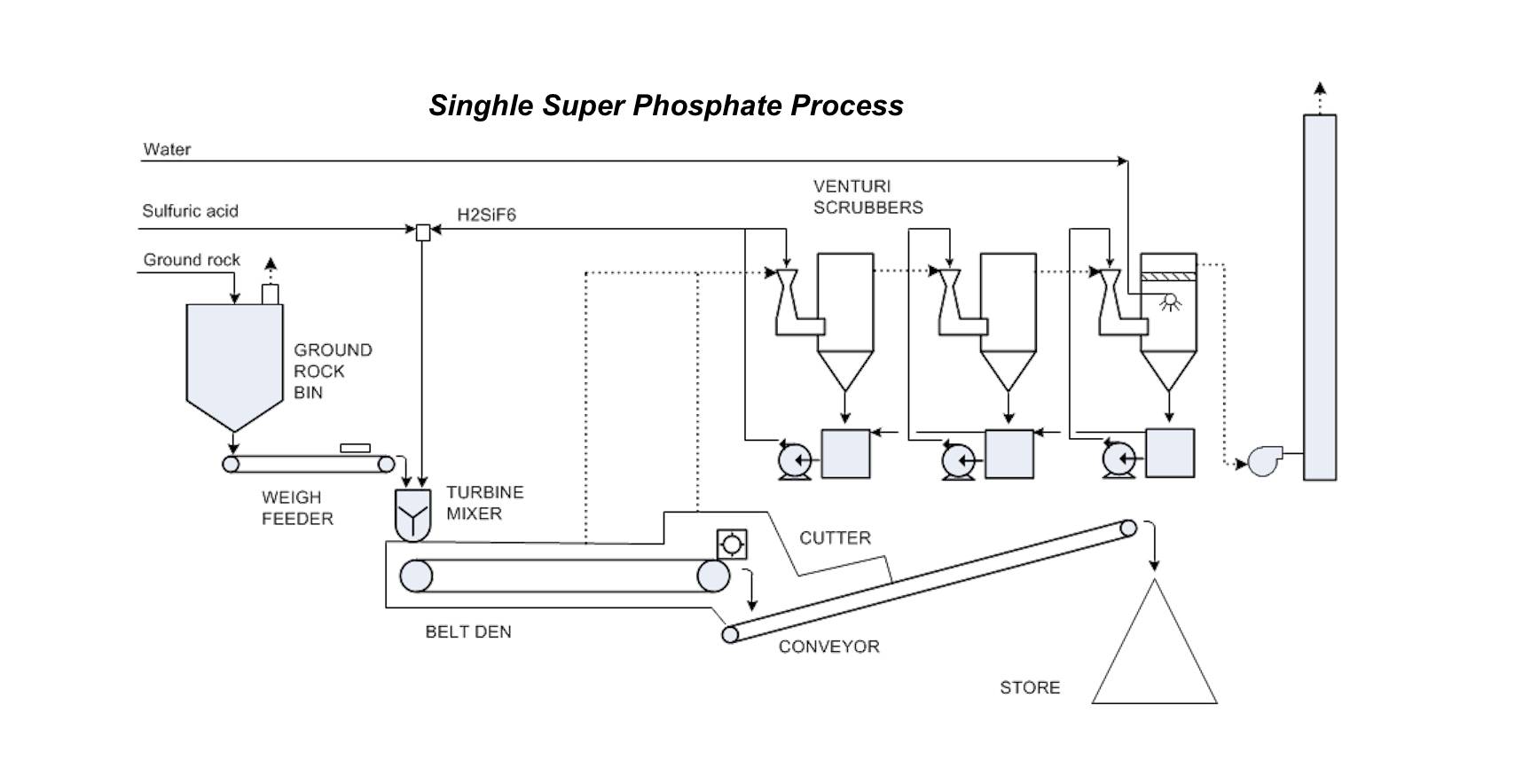
Raw materials are weighed on belt conveyors and combined with recycle material to form a homogeneous process feed.
The powder material enters the granulation drum, where fine water spray supports particle buildup on nuclei and allows control over particle size.
Material moves into the dryer drum, where hot air from the furnace evaporates moisture and helps the partially formed granules develop further.
Ambient air is blown through the cooler drum to stabilize the granules after drying and prepare them for size classification.
Vibrating screens separate the 1–4 mm or required size range, while oversize and undersize material are recycled back into the process after recovery.
Uniform particles are packed precisely into bags, completing the line with consistent finished product handling.
The major reaction converts phosphate rock with sulphuric acid into a more soluble calcium phosphate form.
SSP is made by reacting phosphate rock with sulphuric acid to convert tribasic calcium phosphate into monobasic form. The fertilizer product contains about 14.50% P₂O₅ equivalent.
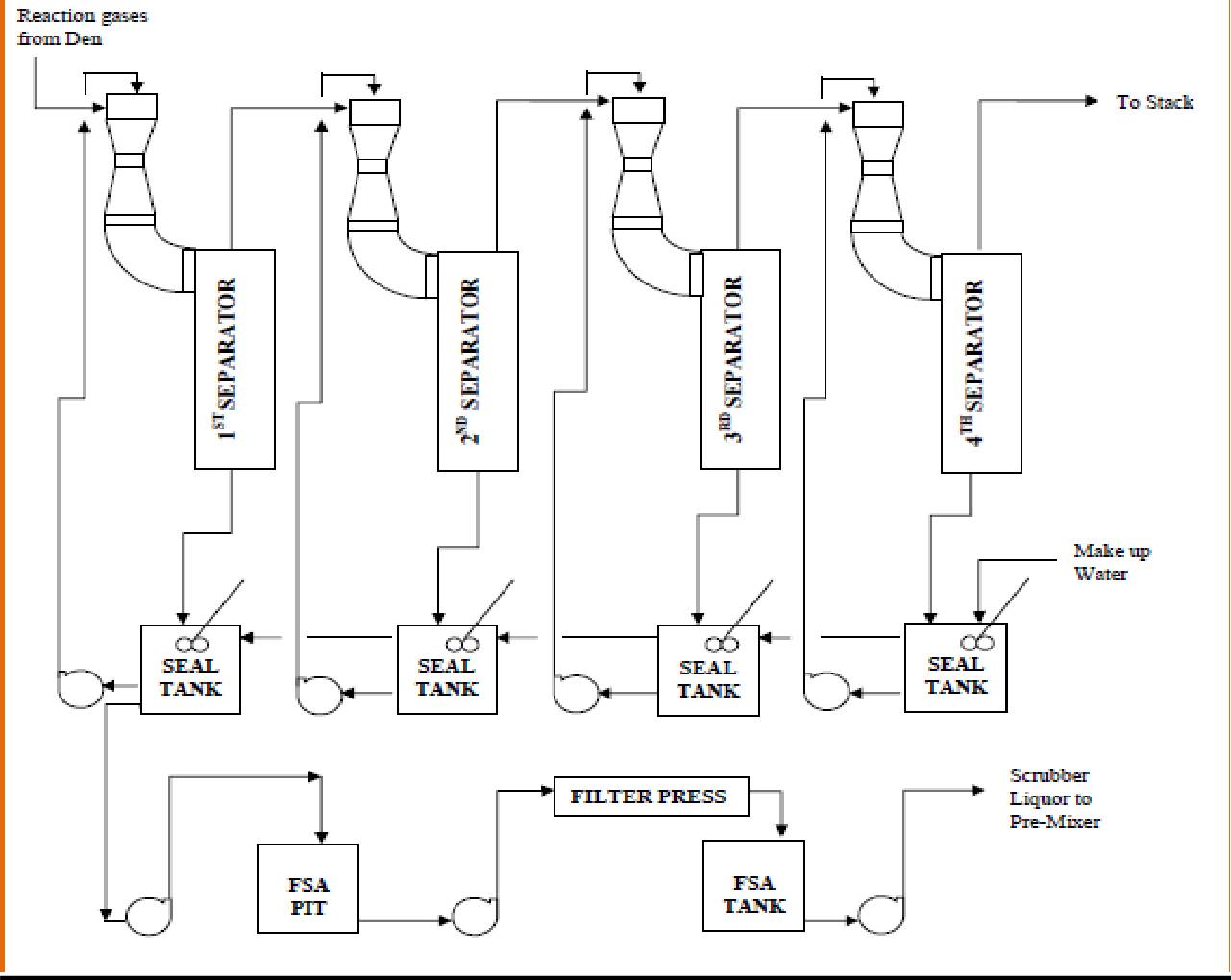
Fluorine-containing gases are a major process consideration in SSP production.
Impurities in the rock can generate HF and SiF₄, which then combine with water to form fluorosilicic acid. These gases are collected by the den scrubbing system, and spray towers or Venturi scrubbers are generally used to manage process emissions.
Fluorine gas evolved from the reactor and den is scrubbed with water in counter-current flow. Fluorosilicic acid generated after scrubbing is recycled to the mixer reactor. Multiple scrubber units may be employed and the process can be configured as a zero-discharge plant.
HF • SiF₄ • Fluorosilicic Acid • Den Scrubbing • Maintenance ReliabilityThe SSP line includes rock preparation, drying, mixing, den reaction, curing, packing and pollution control sections.
Rock phosphate moisture is reduced to roughly 1% in co-current operation with hot air. Typical references include around 300°C inlet hot air and about 60°C outlet temperature.
Rock phosphate is crushed so that about 95% passes through 100 mesh, with dust handling through cyclone separator, blower, and pulse jet dust collector arrangements.
Rock phosphate, sulphuric acid and water form slurry, with acid concentration and retention time supporting better P₂O₅ conversion before transfer to den.
The slurry from mixer spreads on the den surface and remains for reaction and setting before transfer to curing area.
Curing takes around 14 to 21 days, after which powder or granulated product is packed in PP / HDPE 50 kg bags.
Scrubbing and gas handling reduce fluoride-related environmental and maintenance problems during reaction, den and curing stages.
Good process setup improves conversion, handling, environmental control, and overall operating consistency.
We align process logic, equipment understanding, and plant execution support around the real operating behaviour of SSP systems.
We review rock phosphate characteristics, sulphuric acid handling, and target process logic.
We map core sections such as grinding, rock drying, mixing, den, curing, and scrubbing.
We connect feasibility, design engineering, fabrication, supply, installation, and plant operating procedures.
We focus on better conversion, cleaner handling, and more stable plant performance over time.
Whether you are evaluating a new SSP plant, improving an existing line, planning granulation, or strengthening scrubbing and process control, Jobson Enterprises can support the next stage with technically grounded fertilizer-plant expertise.